Katara Cultural Village

Location
Doha, Qatar
Year
2002
Status
Completed
Scope
Architectural design and construction supervision
Client
Katara
A Heritage Village on the Doha Coast
Katara began as an architectural competition for a heritage village in Doha, which one of Odah's founders won. The Qatari authority wanted a low-rise settlement drawing on the old Gulf environment: broken, organic alleyways and buildings arranged around open central courtyards.
The Challenge
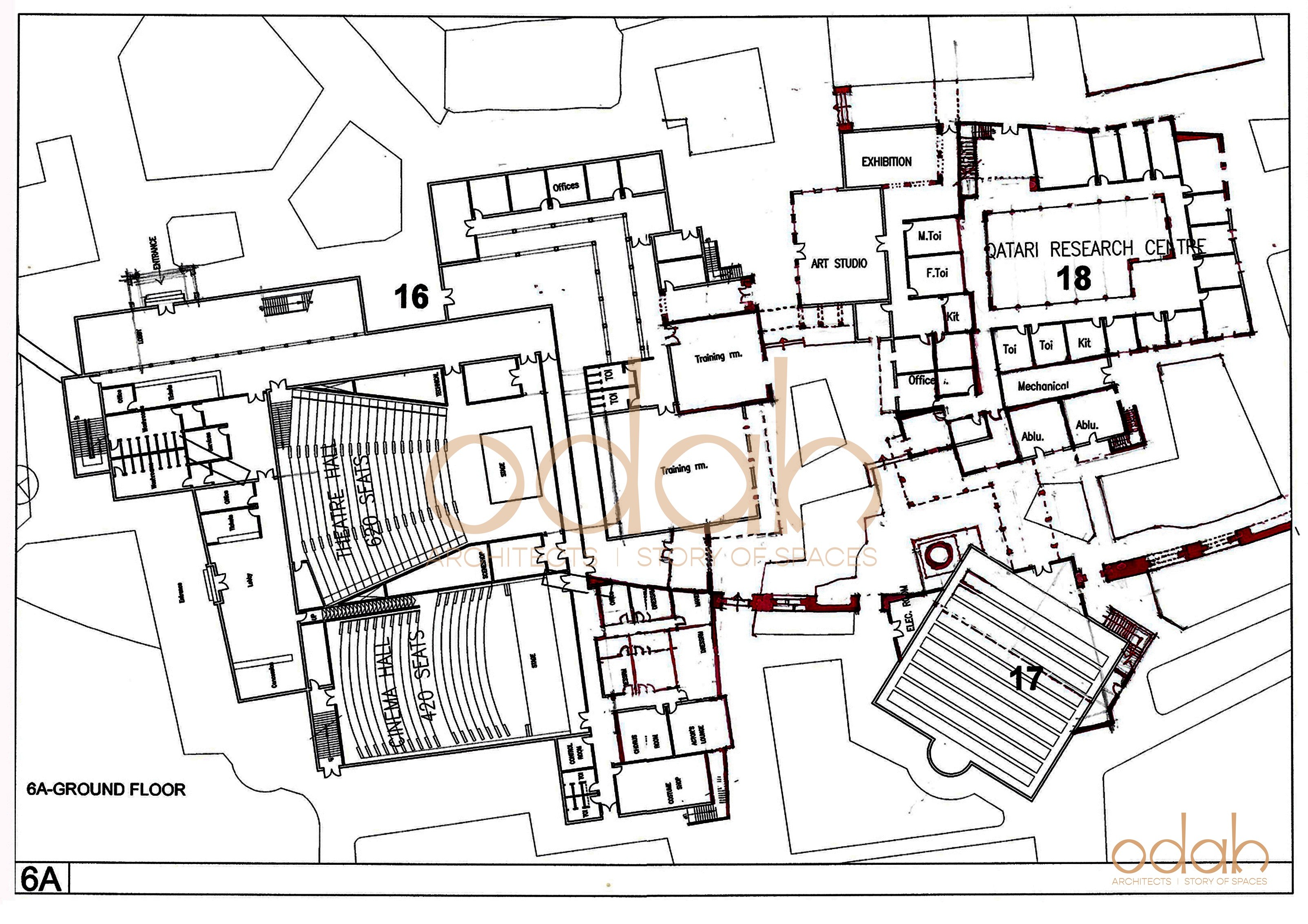
The brief contained a tension. A faithful heritage settlement would have been a museum piece with no means of sustaining itself. Cultural and entertainment functions had to be introduced, a cinema and a theatre, alongside service spaces such as restaurants, cafés and guest rooms in the manner of the old khans, so the project could generate enough income to cover its own maintenance and administration.
The difficulty was accommodating all of this without the result reading as a modern complex dressed in traditional clothing.
The Design
The plan is a cellular fabric, dense at its centre, where the alleys narrow and break as they do in old Gulf settlements. That density then opens suddenly onto a promenade facing the waters of the Gulf.
At the centre of that opening is a semicircular summer amphitheatre looking out over the water. The visual axes running through the fabric converge on it, so that movement through the dense centre resolves where the settlement meets the sea.
Delivery
Design work began in 2002 for Qatar's tourism and cultural authority, the body now known as Katara. Odah provided architectural design and construction supervision.
The Outcome
Katara Cultural Village opened in 2010 and has become one of Doha's principal cultural destinations. It houses a planetarium, a Qatar Museums gallery, the Forum of Arabic and International Relations and the offices of Brooq magazine, and hosts the Traditional Dhow Festival each year.
Since 2014 it has given its name to the Katara Prize for Arabic Novel, one of the Arab world's most significant literary awards, which has drawn more than seventeen thousand entrants over eleven editions.
The heritage village designed to sustain itself through its own cultural programme now anchors a cultural institution of regional standing.